· 4 min read
The Psychological Stability Hierarchy of Needs: A Practical Playbook for Leaders
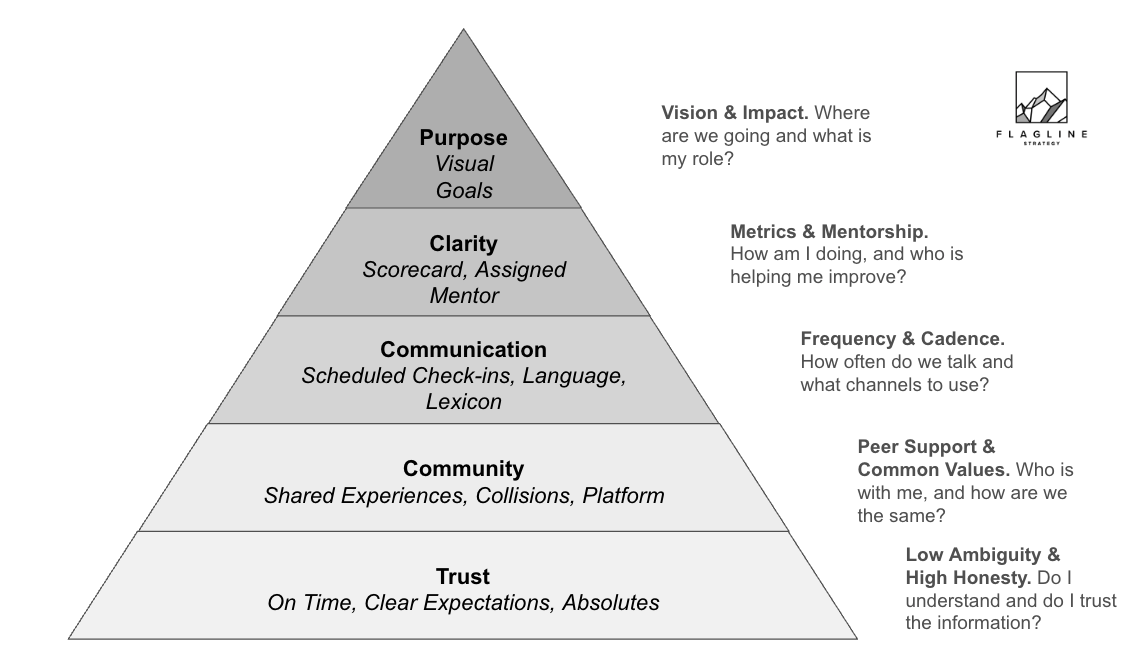
Most performance problems aren’t skill gaps; they’re stability gaps. When people don’t feel anchored—socially, operationally, or directionally—their cognitive load spikes, attention fragments, and output slips. The Psychological Stability Hierarchy of Needs is a simple, operational framework for building that anchor from the ground up: Trust → Community → Communication → Clarity → Purpose. Nail each layer in order, and you create a workplace where people can think, decide, and deliver at their best.
Below is a leader’s field guide to implementing the hierarchy—what each layer means, the failure mode when it’s missing, and exactly what to put in place this quarter.
1) Trust (foundation)
Definition: Reliability and predictability in how we work together—on-time follow-through, clear expectations, and low ambiguity. The operating question is: “Do I understand what’s expected—and can I trust the information?”
When it’s missing: People hedge, duplicate work, and escalate small decisions. Cynicism grows because reality keeps surprising them.
Put this in place:
- Non-negotiables (“absolutes”): Write 5–7 absolutes for your team (e.g., response-time SLAs, definition of “done,” how changes are approved). Publish them in the team’s hub.
- Expectation briefs: For every recurring deliverable, document owner, inputs, output format, success criteria, and due date.
- On-time culture: Track start/stop times and due-date accuracy publicly; coach misses immediately.
Manager ritual (weekly): Review misses with the team, not to punish but to tighten the system—Was the expectation unclear? Was the queue over capacity?
2) Community
Definition: Belonging through shared experiences, “collisions” (intentional cross-team touchpoints), and a common platform that makes peers visible. Core question: “Who is with me, and how are we the same?”
When it’s missing: Lone-wolf behavior, low help-seeking, and “we vs. they” language between functions.
Put this in place:
- Shared experiences: Start or end sprints with 15-minute show-and-tells. Rotate presenters; highlight small wins.
- Designed collisions: Pair adjacent roles for monthly ride-alongs or shadow sessions (e.g., recruiter ↔ background investigator; analyst ↔ operator).
- Community platform: One visible, lightweight space (channel/forum) for kudos, questions, and asks.
Manager ritual (biweekly): Run a “Help Exchange”: each person posts one ask and one offer. Match them live in the meeting.
3) Communication
Definition: Predictable cadence and shared lexicon so information arrives on time and means the same thing to everyone. Working question: “How often do we talk and through which channels?”
When it’s missing: Slack-storms, email novels, and status meetings that confuse more than clarify.
Put this in place:
- Cadence map: Decide what gets communicated daily/weekly/monthly, by whom, and where (standup, dashboard, brief). Post the map.
- Team lexicon: Define terms like “lead,” “qualified,” “blocked,” “priority,” and “urgent.” Print this in the onboarding doc.
- Scheduled check-ins: Protect 1:1s; they’re where nuance lives. Use a standard agenda: wins → blockers → priorities → support needed.
Manager ritual (every standup): Ask “What’s new that changes someone else’s plan today?” Train people to surface impactful info, not everything.
4) Clarity
Definition: Scorecards that show how work is going and mentorship that shows how to improve. Guiding question: “How am I doing, and who is helping me get better?”
When it’s missing: People chase visibility rather than value. Effort is high, impact is random.
Put this in place:
- Role scorecards: 3–5 outcome metrics per role (lagging and leading). Show trendlines and thresholds (green/yellow/red).
- Assigned mentor: Every employee has a named mentor/coach—different from their manager—focused on craft and decision quality.
- Decision logs: Short notes on consequential decisions: context, the bet we made, what we’ll watch next.
Manager ritual (monthly): 30-minute scorecard review—celebrate one metric improvement and pick one capability to level up with the mentor.
5) Purpose (apex)
Definition: A visual, concrete picture of goals that connects individual roles to the mission—“Where are we going and what is my role?”
When it’s missing: Strategy becomes a slogan. People can recite the mission but can’t trace a line from today’s task to tomorrow’s win.
Put this in place:
- Visual goals: Translate the annual plan into a single-page map: 3 company outcomes → 3 team outcomes each → 3 role outcomes each. Hang it where work happens.
- Impact narratives: In town halls, tell “from–to” stories: the current reality, the change we’re making, and what success will look and feel like.
- Line of sight: In 1:1s, ask: “Which of your tasks this week most directly advances Goal X?” If they can’t answer, you have a prioritization issue.
Quick Diagnostic: Find Your First Constraint
Run this 10-minute pulse with your team. Each prompt is rated 1–5 (disagree → strongly agree). Tackle the lowest layer with the lowest score first.
- Trust: “I always know what ‘good’ looks like and what to do next.” “Deadlines and commitments are met.”
- Community: “I know who to go to for help—and they know me.” “We have shared rituals that connect us.”
- Communication: “Important info arrives on a clear cadence.” “Our terms mean the same thing to everyone.”
- Clarity: “My scorecard shows if I’m winning.” “I have a mentor who helps me improve.”
- Purpose: “I can draw a straight line from my work to our goals.” “I see our progress visually.”
30-60-90 Day Rollout
Days 1–30 (Trust + Community):
- Publish your team absolutes and expectation briefs.
- Launch a weekly 15-minute Show & Share; start the Help Exchange.
Days 31–60 (Communication + Clarity):
- Post the cadence map and lexicon; time-box standups to 12 minutes.
- Stand up role scorecards and assign mentors; begin decision logs.
Days 61–90 (Purpose):
- Build the visual goals map and present impact narratives in an all-hands.
- Add a 60-second “line-of-sight” check to every 1:1.
The Meta-Lesson
Stability isn’t the enemy of speed; it’s the precondition. When you stack Trust → Community → Communication → Clarity → Purpose, you reduce noise, increase meaning, and free people to do the best work of their careers. Start at the base, shore up the first weak layer, and you’ll feel the whole system get lighter—fast.