· 6 min read
Exit Planning is Just Good Business: How to Use EOS to Build a "Transferable" Company
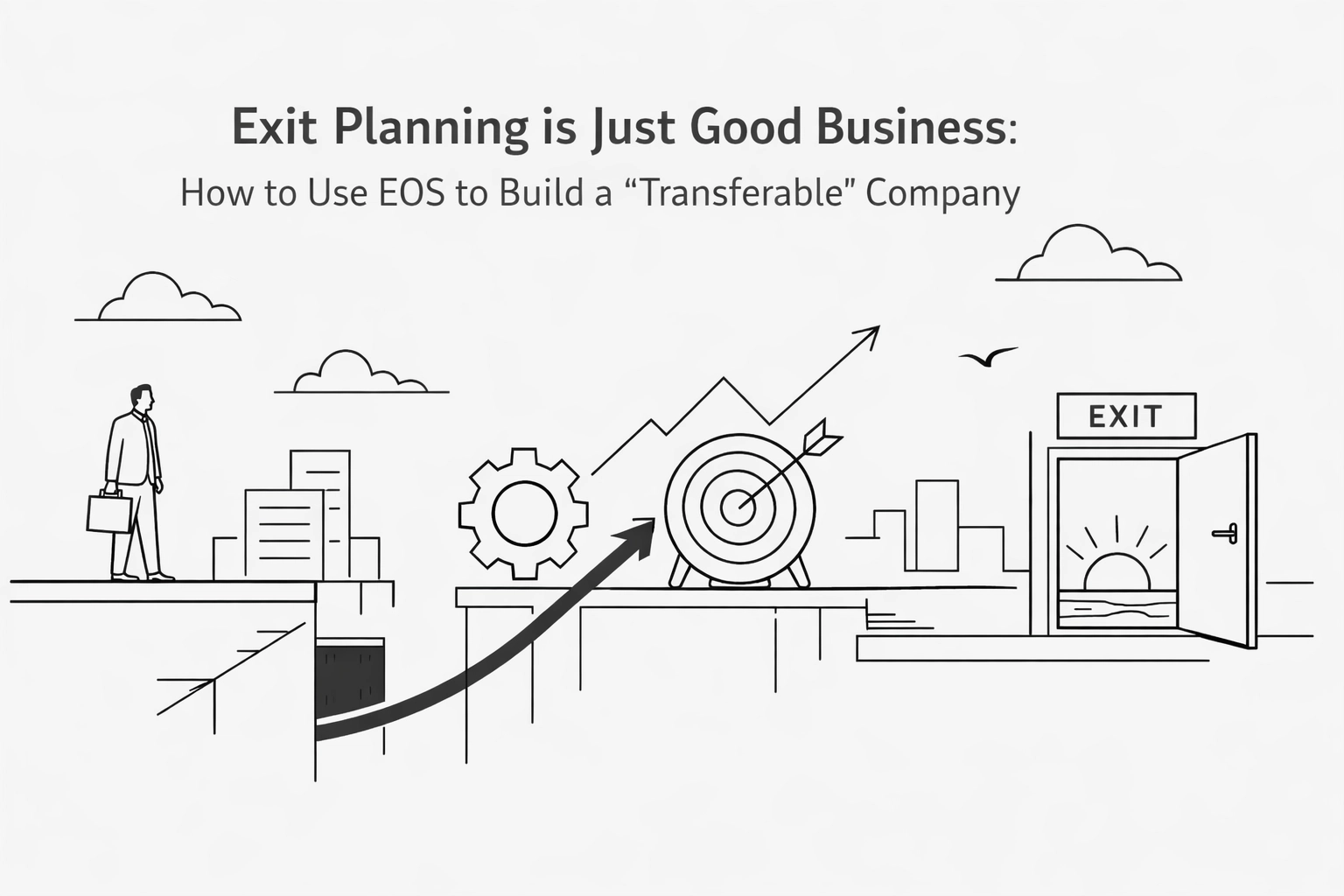
For many business owners, the phrase “exit planning” evokes a distant, dusty shelf of retirement brochures and legal documents. It is often treated as a final act: a somber checklist to be completed only when the founder is ready to trade the boardroom for the golf course. However, this mindset is a strategic error that suppresses company value and traps leaders in a cycle of operational dependency.
In his seminal work Walking to Destiny, Christopher Snider, President of the Exit Planning Institute, reframes the entire concept. Exit planning is not a transaction; it is a strategy for excellence. It is the process of Value Acceleration. The core thesis is simple: a business that is ready to be sold at any time is a business that is better to own every day.
When we integrate Snider’s Value Acceleration Methodology with the Entrepreneurial Operating System (EOS), we create a powerful framework for building a “transferable” company. By focusing on Vision, Traction, and Healthy, we move the business from being owner-centric to being process-centric: the exact transition required to unlock a premium valuation.
The Transferability Trap: The High Cost of Owner-Dependency
The statistics are stark and undeniable: approximately 80% of small-to-mid-sized businesses that go to market never actually sell. Of the 20% that do, many owners leave significant money on the table because they failed to build a transferable asset.
The primary culprit is owner-dependency. When the founder is the chief salesperson, the primary problem-solver, and the sole keeper of the company’s “secret sauce,” the business has no value to a buyer. A buyer is not looking to purchase a job; they are looking to purchase a cash-flow-generating machine that operates independently of any one individual.
This dependency creates a leadership burnout crisis that often forces founders to exit prematurely out of exhaustion rather than strategic readiness. To avoid this, we must shift our focus from income generation to value creation.
Value Acceleration: The Three Legs of the Stool
Snider’s framework suggests that a successful exit (and a high-value business) rests on three inseparable legs:
- Business Readiness: The operational strength and transferability of the company.
- Personal Financial Readiness: Ensuring the owner has enough wealth outside the business to sustain their lifestyle post-exit.
- Personal Readiness: The emotional and psychological preparation for “what comes next.”
Most owners focus exclusively on the first leg, but without the other two, the stool collapses. However, it is within the Business Readiness leg that EOS provides the most significant leverage. By implementing a rigorous operating system, we address what Snider calls the “4 Capitals” of intangible value.
Building Structural Capital Through the Process Component
In the Value Acceleration Methodology, Structural Capital refers to the systems, processes, and data that stay with the company when the owner leaves. It is the “knowledge base” of the organization.
In the world of EOS, this is the Process Component. We help leaders document their “Core Processes”: the 20% of activities that drive 80% of the results. When these processes are documented and Followed by All (FBA), the business gains a predictable rhythm.
A buyer views a documented, systemized business as a low-risk investment. If the company’s success is baked into the “Flagline way” of doing things rather than the founder’s intuition, the value skyrockets. This is the essence of unleashing growth potential and elevating company value: moving from “it’s in my head” to “it’s in the system.”
Human Capital: The Accountability Chart as a Value Driver
Human Capital is the talent and leadership within the organization. A company that relies on a “hub-and-spoke” model: where the owner is the hub and every decision flows through them: is inherently fragile.
The EOS Accountability Chart is a surgical tool for building human capital. By defining the right seats for the business and ensuring we have the Right People in those seats, we create a leadership team that can run the business without the founder.
When a prospective buyer looks at your organization, they aren’t just looking at the P&L. They are looking at the leadership team. Can the team execute the Vision? Do they have a culture of accountability? Are they “Healthy”: meaning they can have honest, vulnerable conversations and solve problems without the founder acting as a referee? A healthy leadership team is a transferable asset; a fractured or dependent one is a liability.

Customer and Social Capital: The Power of the V/TO
The remaining two capitals: Customer (the strength and diversity of your client base) and Social (your brand and culture): are reinforced through the Vision Component.
Using the Vision/Traction Organizer (V/TO), we establish a clear path for the company. This isn’t just a mission statement on a wall; it’s a strategic roadmap that includes:
- The Core Values: Defining the culture (Social Capital).
- The Marketing Strategy: Identifying the ideal customer and the “3 Uniques” (Customer Capital).
- The 10-Year Target: Providing a North Star for the next owner to follow.
When a buyer sees a company with a clear, shared vision and a documented track record of hitting 90-day Rocks, they see a business with momentum. They aren’t just buying your past performance; they are buying your future predictability.
The Timeline: Discover, Prepare, Decide
Snider recommends a 2-to-5-year window for true value acceleration. This timeline aligns perfectly with the journey of an EOS company.
- The Discover Phase: This is often where business coaching begins. We assess the current state of the business, identify the “value gaps,” and get the leadership team aligned on the V/TO.
- The Prepare Phase: This is the “Traction” phase. We implement the meeting pulse, the scorecard, and the process component. We spend 12-24 months building the “structural capital” that makes the business transferable.
- The Decide Phase: With a healthy, systemized, and valuable company, the owner now has options. They can sell to a third party, transition to an internal team, or continue to own the business while stepping back from day-to-day operations.
Exit Planning is a Daily Habit
The paradox of exit planning is that the better you prepare to leave, the more you might actually enjoy staying. When a business is transferable, the “heavy lifting” is shared by the system and the team. The owner is freed up to work on their “Highest and Best Use,” which dramatically reduces stress and prevents the burnout so common in mid-market leadership.
At Flagline Strategy, we help you navigate this transition. Whether you are eyeing an exit in three years or thirteen, the work is the same: build a business that doesn’t need you.
Action Steps for Value Acceleration
- Assess Your Dependency: If you took a 30-day vacation tomorrow with no phone access, what would happen to your business? Your answer is a direct reflection of your company’s transferability.
- Audit Your Processes: Identify the three core processes that drive the most value. Are they documented? Is everyone following them?
- Strengthen Your Leadership Team: Use the People Analyzer to ensure you have the right people in the right seats. If you are still making every major decision, you are a bottleneck to your own wealth.
- Focus on Intangible Assets: Start measuring your “4 Capitals.” It’s not just about the EBITDA; it’s about the multiple that a buyer will pay for your structural and human capital.
Exit planning isn’t about the end of the road. It’s about ensuring that every step you take today is building a legacy of value. If you’re ready to start “Walking to Destiny,” let’s ensure your business has the structure and clarity it needs to reach the summit.