· 8 min read
Blue Ocean Strategy Meets EOS: How to Find Uncontested Space and Actually Execute It
Most leadership teams are exhausted from fighting battles they can’t win. They’re competing on price, matching competitor features, and burning through resources in markets where differentiation has become nearly impossible. This is the red ocean: where the water is bloody from competition and everyone is fighting over the same shrinking customer base.
The problem isn’t effort. It’s direction.
Blue Ocean Strategy, developed by W. Chan Kim and Renée Mauborgne, offers a fundamentally different approach: stop competing in existing market space and create uncontested market space instead. Rather than dividing up existing demand, Blue Ocean Strategy focuses on growing demand and making the competition irrelevant through value innovation: the simultaneous pursuit of differentiation and low cost.
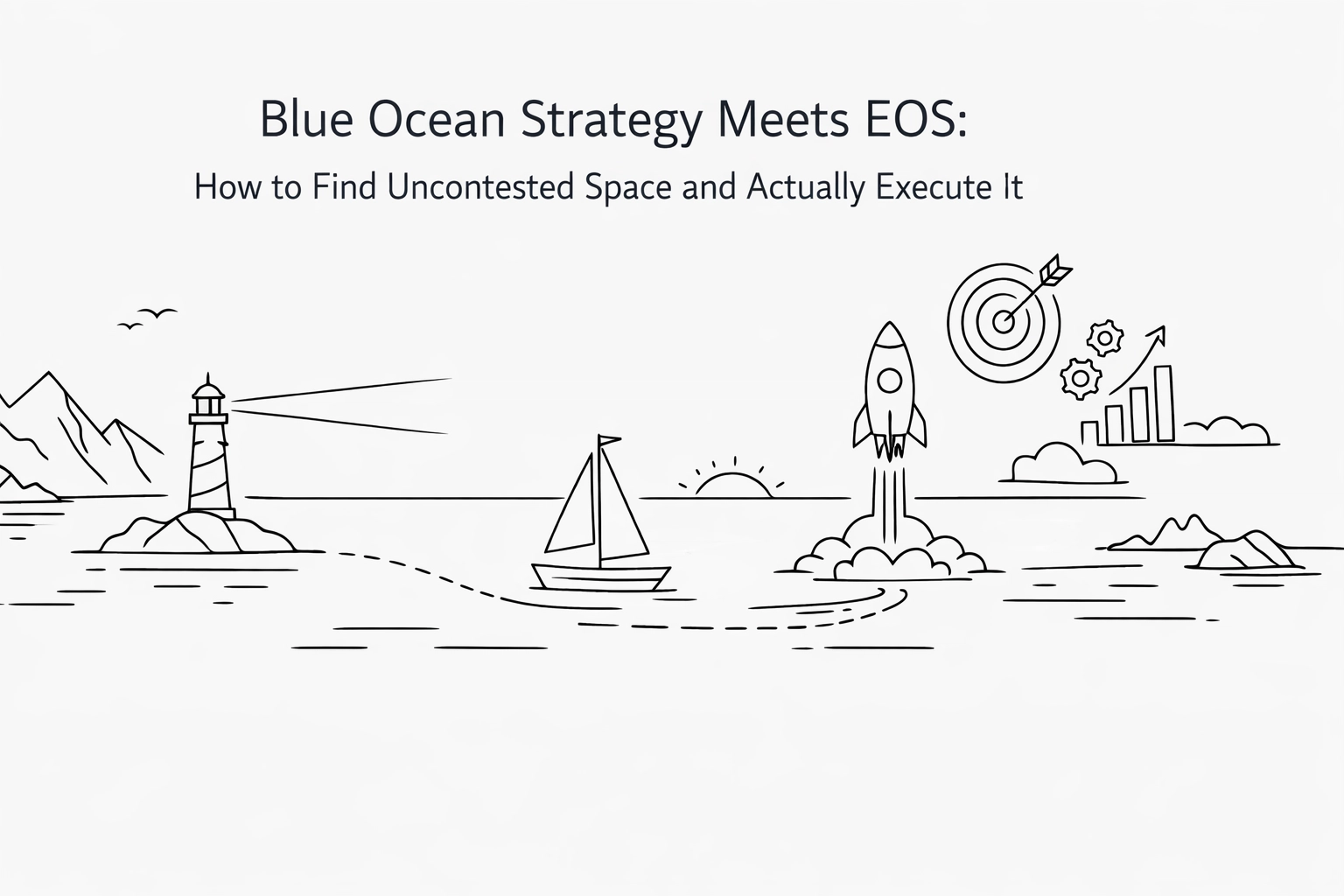
But here’s where most strategic frameworks fall apart: brilliant strategy without execution discipline is just an expensive consulting deck gathering dust. This is precisely where the Entrepreneurial Operating System (EOS) becomes the critical complement. Blue Ocean Strategy tells you where to go. EOS gives you the operating system to actually get there.
The Blue Ocean Imperative: Why Uncontested Space Matters Now
The traditional competitive playbook: outperform rivals on existing value propositions: has reached a point of diminishing returns in most industries. When everyone is optimizing for the same factors, competition becomes a zero-sum game that erodes profit margins and commoditizes entire sectors.
Kim and Mauborgne’s research across 150 strategic moves spanning more than 100 years revealed a stark pattern: value innovation, not competitive benchmarking, drives profitable growth. Companies that created blue oceans: Cirque du Soleil redefining circus entertainment, Southwest Airlines making flying accessible, Netflix transforming content consumption: didn’t beat the competition. They made it irrelevant by reconstructing market boundaries entirely.
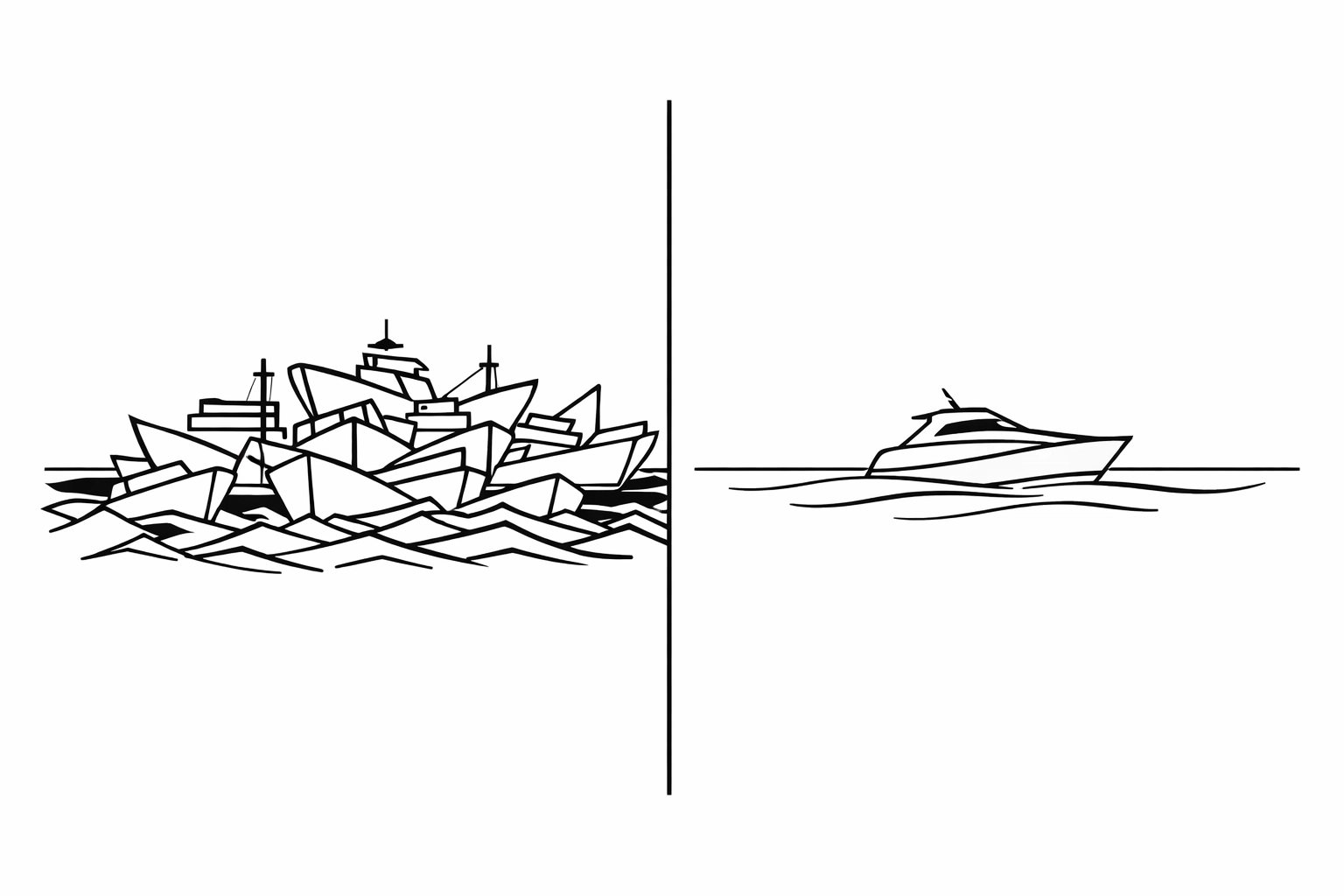
The value proposition is twofold: Blue Ocean Strategy simultaneously expands your addressable market while reducing cost structure. This isn’t about choosing between differentiation or cost leadership: it’s about achieving both through systematic elimination and creation of value factors. The result isn’t incremental improvement but quantum leaps in buyer value and company economics.
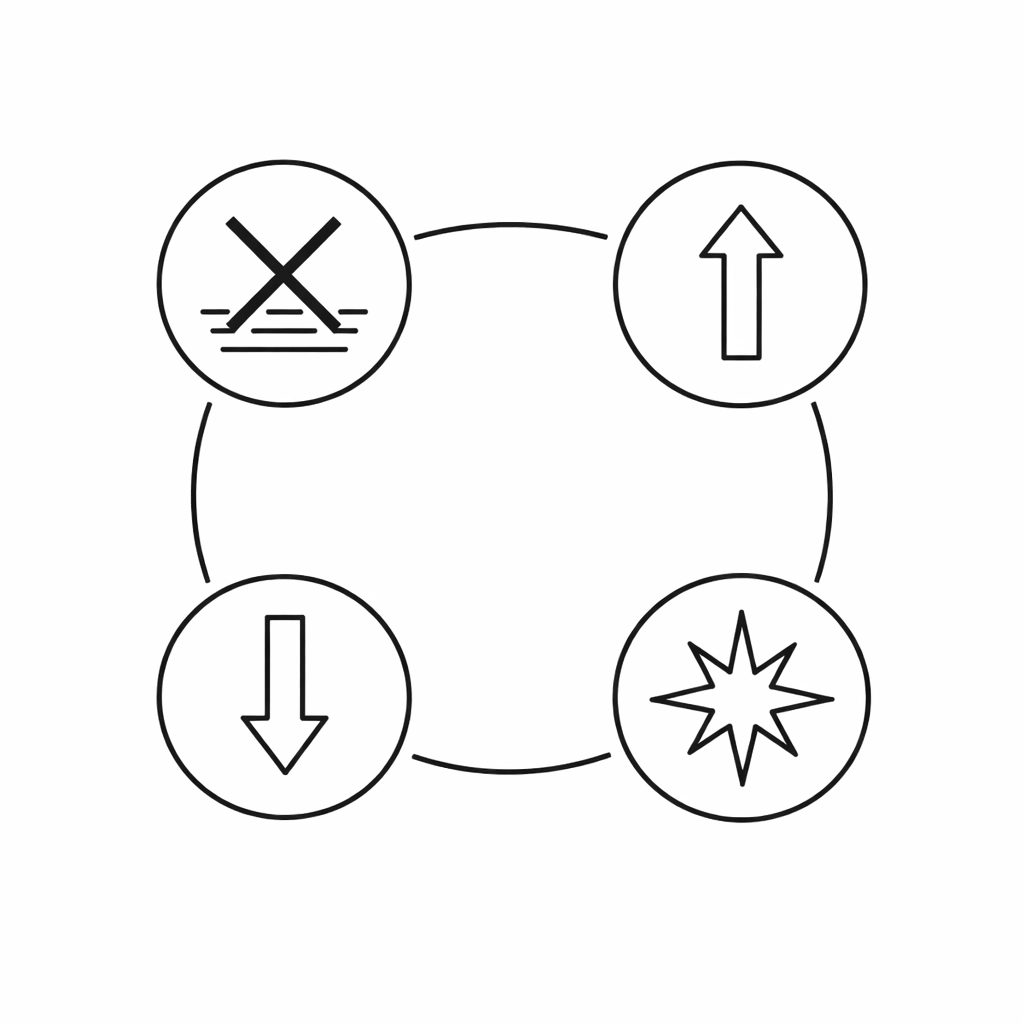
Consider the Four Actions Framework at the heart of Blue Ocean Strategy:
- Eliminate: Which factors the industry takes for granted should be eliminated?
- Reduce: Which factors should be reduced well below the industry’s standard?
- Raise: Which factors should be raised well above the industry’s standard?
- Create: Which factors should be created that the industry has never offered?
This framework forces leadership teams to challenge industry orthodoxy systematically. Most strategic planning sessions focus on how to compete better within existing parameters. Blue Ocean thinking asks: what if we changed the parameters entirely?
The Execution Gap: Where Strategy Dies
Peter Drucker famously observed that “culture eats strategy for breakfast.” The corollary is equally true: operational chaos eats strategy for lunch. The business landscape is littered with brilliant strategic insights that never translated into sustainable competitive advantage because organizations lacked the discipline to execute consistently.
This is where EOS provides the complementary framework. While Blue Ocean Strategy helps you identify uncontested market space, EOS gives you the operating system to:
- Crystallize that vision into actionable components
- Align your entire organization around the strategic direction
- Build accountability mechanisms that ensure follow-through
- Create communication rhythms that keep everyone synchronized
The synergy becomes apparent when you examine the EOS Vision/Traction Organizer (V/TO): specifically the Vision component. This isn’t generic visioning work. It’s a structured approach to answering eight critical questions, and Blue Ocean Strategy directly informs two of the most challenging ones: The Three Uniques and your Proven Process.
Blue Ocean Meets The Three Uniques
The Three Uniques in EOS ask: what three things make your company truly different from competitors? Most companies struggle here because they’re thinking in red ocean terms: “we have better customer service,” “we’re more responsive,” “we use higher quality materials.” These aren’t uniques. They’re table stakes dressed up as differentiation.
Blue Ocean Strategy provides the analytical rigor to identify genuine uniques by examining the entire competitive landscape through the Strategy Canvas: a diagnostic framework that captures the current state of play in the known market space. By plotting your company and competitors on key competing factors, you visualize where everyone is competing on the same dimensions and where opportunity for reconstruction exists.
When you apply the Four Actions Framework to your industry’s Strategy Canvas, patterns emerge: factors you’ve been competing on that add cost but little buyer value, factors you’ve neglected that could unlock new demand, and combinations that no one has assembled before. These insights: grounded in systematic analysis rather than wishful thinking: give you the foundation for authentic uniques.
For example, if your Four Actions analysis reveals that customers don’t actually value the elaborate customization options your industry offers (eliminating complexity and cost) but desperately want faster deployment timelines (creating a new value factor), your unique becomes: “We deliver standardized solutions that go live in weeks, not months: no customization paralysis, no integration nightmares, just results.”
That’s a unique born from Blue Ocean thinking: you’ve eliminated factors (customization), created factors (rapid deployment), and in doing so, opened uncontested space. Your competition can’t easily follow because their entire business model and cost structure is built around the old competitive factors.
Defining Your Proven Process Through Blue Ocean Thinking
The Proven Process component of the V/TO asks you to articulate the unique way you do what you do: the methodology or system that distinguishes your approach. Again, most companies default to generic descriptions of their workflow. Blue Ocean Strategy pushes you toward genuine process innovation.
When you reconstruct market boundaries, you often need to reconstruct internal processes to deliver on the new value proposition. This isn’t process improvement: it’s process innovation designed to support your blue ocean position. The Proven Process you document in your V/TO should reflect the operational capabilities required to deliver on your Three Uniques.
If your blue ocean strategy involves eliminating certain industry complexity factors, your Proven Process needs to codify how you achieve simplicity without sacrificing effectiveness. If you’re creating new value factors, your Proven Process must detail the systematic approach that makes those factors consistently deliverable at scale.
This is where the marriage of strategy and execution becomes tangible. Blue Ocean Strategy defines the “what” and “why” of your differentiation. EOS’s Proven Process defines the “how”: and more importantly, makes that “how” trainable, scalable, and defensible.
From Strategy to Traction: The Integration Model
Jim Collins’s research in “Good to Great” emphasized that great companies think like hedgehogs: they know the one thing they can be the best in the world at, and they organize everything around that singular insight. Blue Ocean Strategy helps you discover that insight by analyzing the competitive landscape for reconstruction opportunities. EOS helps you become disciplined about actually being that thing: consistently, organization-wide, quarter after quarter.
The integration model works through several mechanisms:
Vision Alignment: Your blue ocean positioning informs every aspect of the V/TO: from your Core Target (who benefits most from the uncontested space you’ve created) to your Marketing Strategy (how you communicate your differentiation). EOS ensures these aren’t aspirational statements but working documents that guide quarterly Rocks and Weekly Level 10 Meetings.
Accountability Structure: Finding blue ocean space requires one set of capabilities. Executing in that space requires another. The EOS Accountability Chart maps who owns which aspects of strategy execution, ensuring someone is responsible for defending and expanding your blue ocean position as competitors inevitably attempt to follow.
Data-Driven Refinement: The EOS Scorecard: weekly metrics that predict future outcomes: helps you measure whether your blue ocean strategy is delivering the promised results. Are you seeing expanded demand? Are cost structures declining as promised? Are competitors struggling to follow? These become measurable indicators, not abstract hopes.
Issue Solving Discipline: As you execute your blue ocean strategy, obstacles emerge: operational challenges in delivering the new value proposition, market education needs, internal resistance to changed processes. EOS’s Issues Solving Track (Identify, Discuss, Solve) provides the structured approach to clearing these execution barriers systematically.

The Compounding Advantage: Strategy That Actually Compounds
Most strategic advantages erode over time as competitors copy successful moves. But blue ocean positions defended with operational excellence create compounding advantages that become increasingly difficult to replicate. Each quarter you execute well in uncontested space, you’re building capabilities, brand recognition, and customer relationships that raise the barriers to competitive following.
This is why the combination matters so profoundly. Blue Ocean Strategy without EOS execution often results in first-mover disadvantage: you create the market, validate demand, and then better-executing competitors capture the value you’ve created. EOS without Blue Ocean thinking often results in operational excellence aimed at the wrong target: you’re becoming world-class at competing in commoditized red oceans.
Together, they create what Michael Porter would call a reinforcing activity system: your strategic positioning informs your operational choices, and your operational capabilities enable strategic moves competitors can’t match. The result isn’t just competitive advantage: it’s sustained competitive advantage that grows stronger rather than weaker over time.
Making It Real: Your Next Quarterly
If you’re running on EOS, your next Quarterly Meeting presents the opportunity to inject Blue Ocean thinking into your strategic refresh. Before you set Rocks for the coming quarter, take your leadership team through the Four Actions Framework applied to your industry:
- What factors are we competing on that we could eliminate entirely?
- What factors are we over-delivering on relative to customer value?
- What factors could we raise that would unlock new demand?
- What factors could we create that don’t exist in our space today?
Document the insights on a Strategy Canvas. Then ask: if we pursued this reconstruction, what would our Three Uniques become? How would our Proven Process need to evolve? What Rocks would we set to move toward this blue ocean position?
This isn’t about abandoning EOS discipline for strategic flights of fancy. It’s about ensuring that discipline serves a strategy worth executing: one that leads you toward uncontested space rather than optimizing your position in bloody waters. The most disciplined ship still sinks if it’s sailing toward the wrong destination.
Blue Ocean Strategy provides the navigation. EOS provides the vessel and crew discipline to actually reach the destination. Neither works optimally without the other. But together, they give you both the vision of possibility and the operational rigor to make that possibility real: repeatedly, reliably, and with compounding advantage over time.