
Beyond Good - Why Your Leadership Team Needs a Flywheel Not Just a Meeting

Your leadership team gathers every week. You run your Level 10 meetings with discipline. Issues get solved, to-dos get assigned, and everyone leaves with clarity on what's next.
And yet, you're still not seeing the breakthrough momentum you know is possible.
Here's the uncomfortable truth: meetings alone don't create greatness. They create structure, accountability, and short-term progress. But true organizational momentum, the kind that compounds week after week until your company becomes unstoppable, requires something fundamentally different.
It requires a flywheel.
The Flywheel: Jim Collins' Framework for Sustainable Momentum
In Good to Great, Jim Collins introduced the flywheel concept to explain how great companies don't achieve success through a single defining action or miracle moment. Instead, they build momentum through a self-reinforcing cycle of disciplined actions that, when repeated consistently, create unstoppable forward motion.
Collins describes it this way: pushing a massive flywheel requires enormous effort at first. The first rotation is brutal. The second is only marginally easier. But with consistent, aligned effort in the same direction, the wheel begins to turn faster. Eventually, the accumulated momentum carries the organization forward with less effort than it took to get started.
The breakthrough isn't the result of one heroic push, it's the cumulative effect of dozens of consistent, aligned actions that build on each other over time.
This is where most leadership teams get it wrong. They confuse activity with momentum. They mistake the meeting for the mechanism that creates compounding results.
Why Meetings Are Necessary But Not Sufficient
Let's be clear: EOS Level 10 meetings are essential infrastructure. They provide the rhythm, accountability, and problem-solving discipline that prevent organizational chaos. Without them, companies drift, issues fester, and leaders spend their time fighting fires instead of driving strategy.
But here's what meetings don't do on their own: they don't create the compounding momentum that transforms a good company into a great one.
Think about it this way, a meeting is a snapshot in time. It's a weekly checkpoint where you identify issues, make decisions, and assign actions. When the meeting ends, the work begins. But if that work isn't connected to a larger, self-reinforcing system, you're just churning through tasks without building velocity.
Patrick Lencioni, author of The Advantage, describes organizational health as the multiplier of intelligence. Your company can be smart, great strategy, talented people, solid processes, but without the disciplines that create alignment and momentum, that intelligence never compounds into breakthrough performance.
This is the difference between isolated effort and integrated momentum. Meetings provide the forum for alignment. The flywheel provides the system that turns alignment into acceleration.
The EOS Traction Component: Where Discipline Meets Momentum
In the Entrepreneurial Operating System, Traction is the component that brings vision to life through execution. It's the discipline of establishing priorities, creating accountability through measurable goals (Rocks), and maintaining a consistent meeting rhythm that keeps everyone focused on what matters most.
But here's what Gino Wickman understood when he built EOS: Traction isn't just about completing tasks, it's about creating a cadence of execution that builds on itself.
This is the flywheel in action within EOS:
Clarity on what matters most (your Rocks) creates focus. Focus drives disciplined execution. Disciplined execution produces results. Results build confidence. Confidence increases commitment. Commitment fuels the next cycle of focused execution, but now with more velocity than the last cycle.
Organizations that embed this rhythm into their operating system see measurable returns. Research shows that companies integrating leadership development and strategic alignment as continuous practices, not annual events, experience up to 29% higher revenue per employee and 21% greater profitability compared to those relying on sporadic investments.
The difference? They've built a flywheel, not just a meeting schedule.
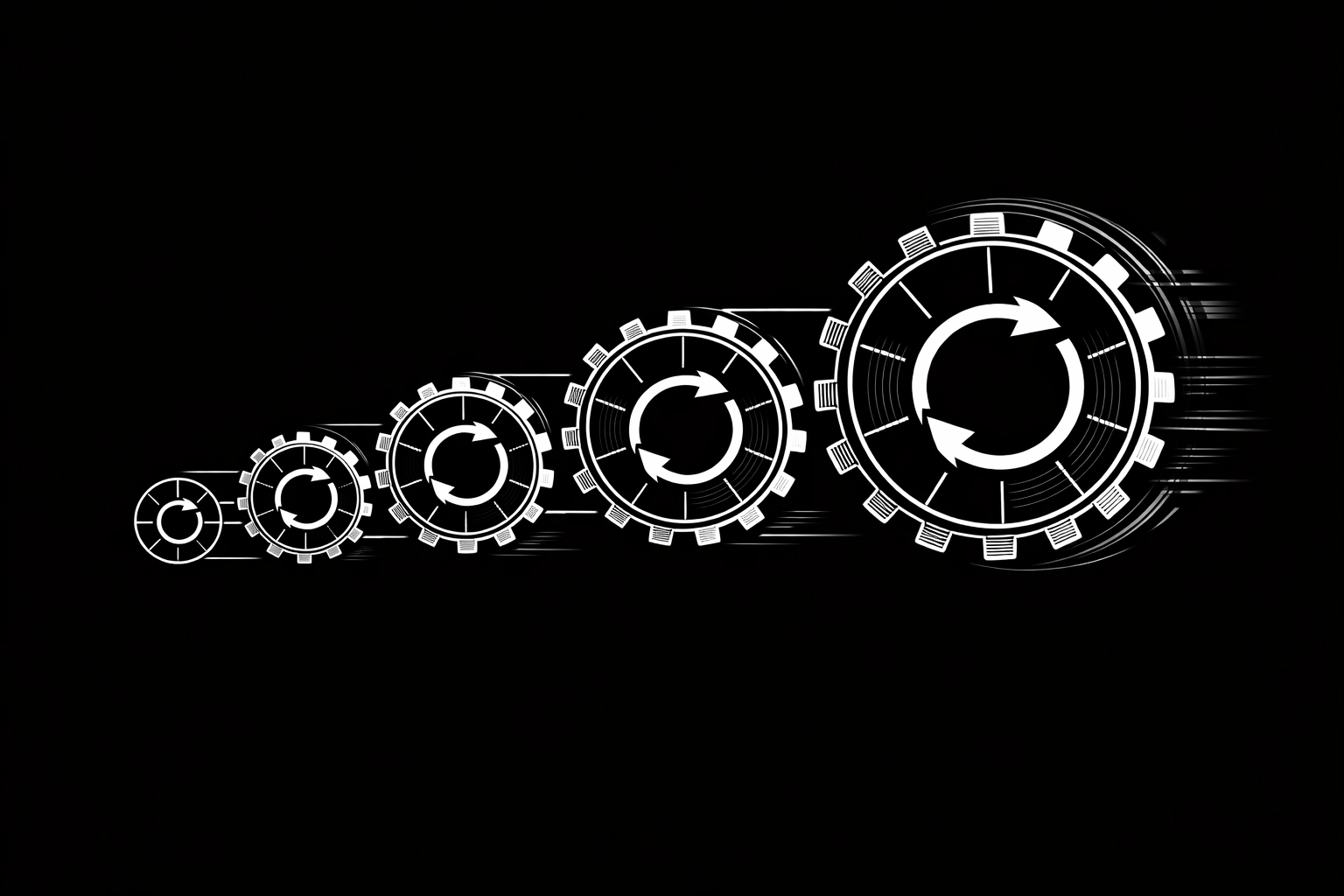
The Five Turns of the Leadership Flywheel
So what does a leadership flywheel actually look like in practice? Here's how the most effective leadership teams create self-reinforcing momentum:
Turn One: Strategic Clarity Your flywheel begins with alignment on the five to seven most important drivers of business momentum. Not thirty priorities. Not "everything matters." The handful of initiatives that, if executed with excellence, will move the organization forward faster than anything else.
This is where your EOS V/TO (Vision/Traction Organizer) becomes the filter. Every decision, every investment of resources, every Rock gets measured against one question: Will this help our flywheel spin faster?
Turn Two: Disciplined Execution Clarity without execution is just aspiration. The second turn of the flywheel is the consistent, weekly rhythm of Level 10 meetings where Rocks get tracked, issues get solved, and accountability becomes non-negotiable. This is where EOS shines, creating the operating discipline that prevents drift.
But here's the critical insight: execution isn't about working harder. It's about working on the right things with cumulative effect. Each completed Rock doesn't just close a project, it adds weight to the flywheel, making the next turn easier.
Turn Three: Measured Progress You can't improve what you don't measure. The third turn of the flywheel is the consistent tracking of leading indicators through your EOS Scorecard. These aren't vanity metrics, they're the weekly pulse checks that tell you whether the flywheel is accelerating or stalling.
Organizations that measure what matters create a feedback loop that informs the next cycle of execution. This is where momentum becomes visible and teams start to feel the acceleration.
Turn Four: Learning and Adaptation No plan survives first contact with reality unchanged. The fourth turn of the flywheel is the discipline of reflection, using your quarterly planning sessions and annual reviews to ask what's working, what's not, and how to adjust the flywheel for even greater velocity.
This is where good companies plateau and great companies compound. The willingness to refine the flywheel, to let go of what's no longer serving momentum, and to double down on what's working separates consistent performers from exceptional ones.
Turn Five: Cultural Reinforcement The final turn of the flywheel is the most powerful: when disciplined execution becomes embedded in your culture. When accountability isn't enforced, it's expected. When strategic focus isn't a leadership mandate, it's how everyone thinks.
This is the breakthrough moment Collins describes. What once required enormous effort, building trust, maintaining discipline, driving accountability, becomes natural. The flywheel has enough momentum that it starts to pull the organization forward.
The Compounding Effect: Why Time Is Your Ally
Here's where the flywheel concept becomes transformational: momentum compounds exponentially, not linearly.
In your first quarter using EOS, completing your Rocks might feel like pushing a boulder uphill. Meetings feel like work. Accountability feels forced. Progress feels incremental.
By quarter three, something shifts. The team starts to anticipate issues before they become crises. Rocks get completed ahead of schedule. The scorecard shows consistent improvement. The flywheel is turning.
By year two, you look back and realize the organization has fundamentally transformed. Revenue has grown, but more importantly, the quality of execution has improved. Decision-making is faster. Alignment is stronger. The culture has shifted from reactive to proactive.
This is the power of cumulative momentum. Each disciplined quarter doesn't just move you forward, it makes the next quarter easier and more effective.
Compare this to the company that treats each quarter as a standalone effort. They have meetings. They set goals. They even complete projects. But without the self-reinforcing system of a flywheel, they reset to zero each quarter. They're perpetually pushing the boulder from a standstill instead of maintaining and accelerating momentum.
From Good to Great: What It Takes
Jim Collins' research in Good to Great revealed a pattern among companies that made the leap from good performance to exceptional performance. It wasn't a single strategy, a charismatic CEO, or a revolutionary product. It was the disciplined accumulation of aligned effort over time.
The flywheel is the mechanism that makes this possible.
But here's the hard truth: building a flywheel requires patience in a world that demands instant results. It requires the discipline to say no to distractions when opportunities feel urgent. It requires leadership teams to trust the process even when the first few turns feel impossibly slow.
This is where most organizations fail. They start pushing the flywheel, don't see immediate results, and abandon the effort for the next shiny strategy. They trade long-term momentum for short-term activity.
The companies that become great do the opposite. They commit to the flywheel. They show up every week. They run their Level 10 meetings with discipline. They complete their Rocks. They track their metrics. They adjust and refine. And they trust that cumulative momentum will deliver breakthrough results.
Your Next Turn
If your leadership team is running meetings but not building momentum, it's time to shift from isolated activity to integrated systems. The question isn't whether you need structure: you do. The question is whether that structure is creating a self-reinforcing cycle that compounds week after week.
Your Level 10 meetings are essential. But they're not sufficient. True greatness requires the discipline to build a flywheel: to identify the five to seven most important drivers of your business, align every action behind them, and commit to the consistent execution that turns effort into unstoppable momentum.
The first turn is the hardest. The breakthrough comes later. But it only comes if you keep pushing in the same direction, week after week, quarter after quarter, until the accumulated weight of disciplined execution carries you forward.
That's how good companies become great. Not through meetings alone: but through the flywheel those meetings serve.
Ready to build momentum that compounds? Email ryan@flaglinestrategy.com to discuss how EOS can help your leadership team create a flywheel that drives sustainable growth.


Comments